Music’s my language. Tuba’s my voice.
At my core, I’m a storyteller. Everything I do—tuba playing, composition, spoken word, and teaching—is rooted in sharing my truth and giving voice to the parts of myself I once tried to hide. Embracing this version of my artistry has been a slow, evolving process, one that continues to shape how I show up in the world and in my work.
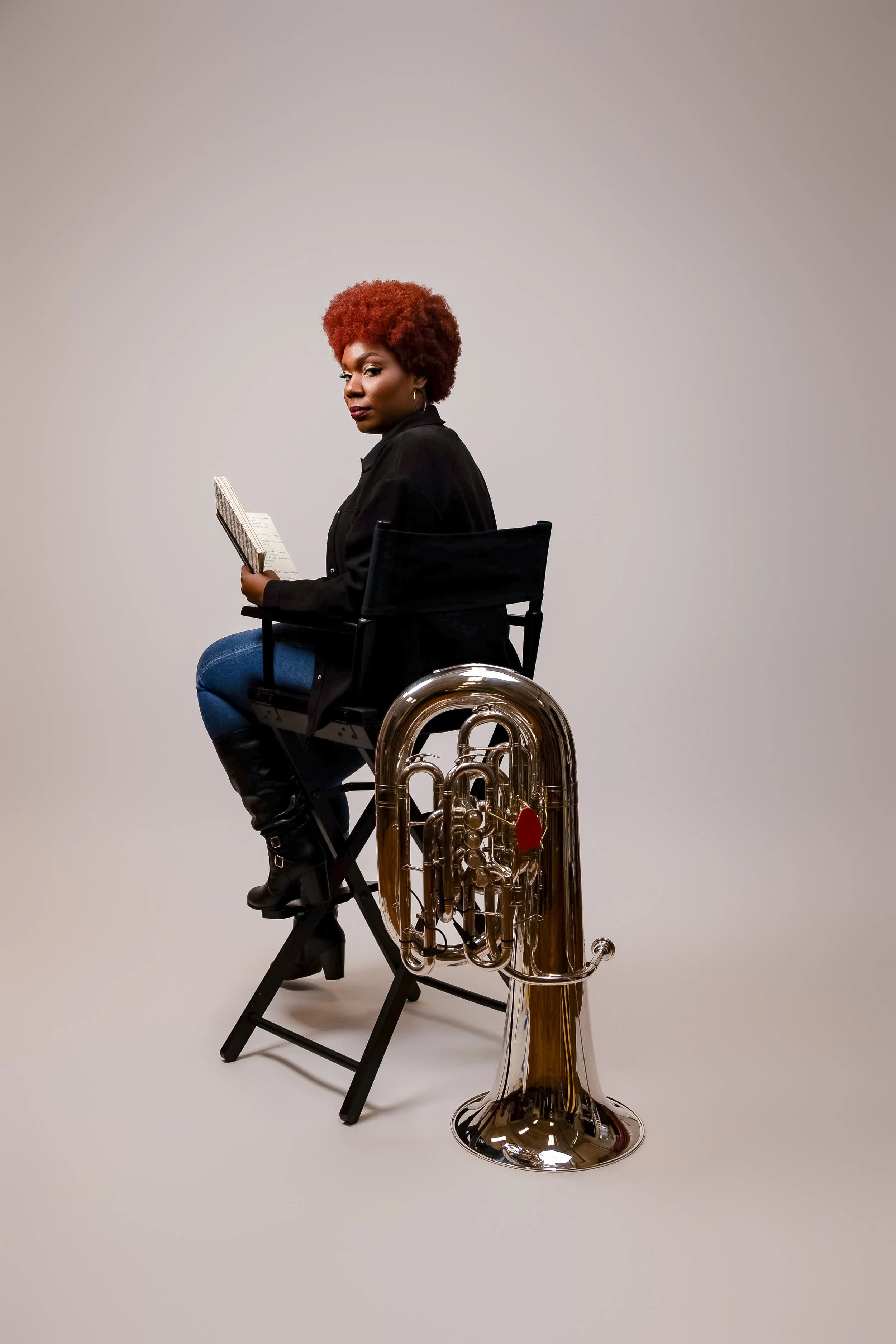
I make music to speak my truth.
Before the career, awards, and degrees, I was just a girl who wanted to be heard. I was drawn to the tuba because of the kids' show Veggie Tales. Something about its size and power called to me in the show’s opening theme. As a kid who often faded into the background, the tuba felt like a way to take up space and express myself on my own terms. I didn’t get it right at first (fourth-grade me accidentally picked the trombone) but a year later, at ten years old, I finally had the chance to switch. That moment changed everything.
Around the same time, creative writing entered my life. I spent my childhood building imaginary worlds and stories, and when the games stopped, I turned to the page. Writing became my escape and my first language of expression. I spent hours a day writing novels, short stories, and poetry to release my creative energy. Even after choosing music as my career, I kept writing privately. In early undergrad, I realized just how deeply the two disciplines connected: I began to create stories to help me interpret and bring life to the pieces I was performing.
My first recital at Ithaca College showed me what was possible when I let those worlds merge openly. In my sophomore year, I performed James Grant’s Ten Blind Dates for Solo Tuba, inviting friends to act out each movement. That recital was transformative. I saw how storytelling made music accessible, enjoyable, relatable—and I wanted more.
In 2018, I experienced that power in a new context. Through the Promising Artists of the 21st Century cultural exchange program, I toured Costa Rica with colleagues Fred Peterbark (tenor) and Oliver Scott (piano), performing and teaching in Limón, Santa Ana, and Santo Domingo. Those performances of Negro Spirituals, Gospel, and Classical music reminded me how music communicates struggle, hope, faith, and resilience across the barriers of language and culture.
During the pandemic, my artistry expanded again. I leaned into composition and spoken word, exploring themes of identity, expression, vulnerability, and self-discovery. What began as two separate passions—music and creative writing—finally fused into a single practice.
That fusion became the heart of my work: creating art that is honest, relatable, and rooted in the shared human experience.
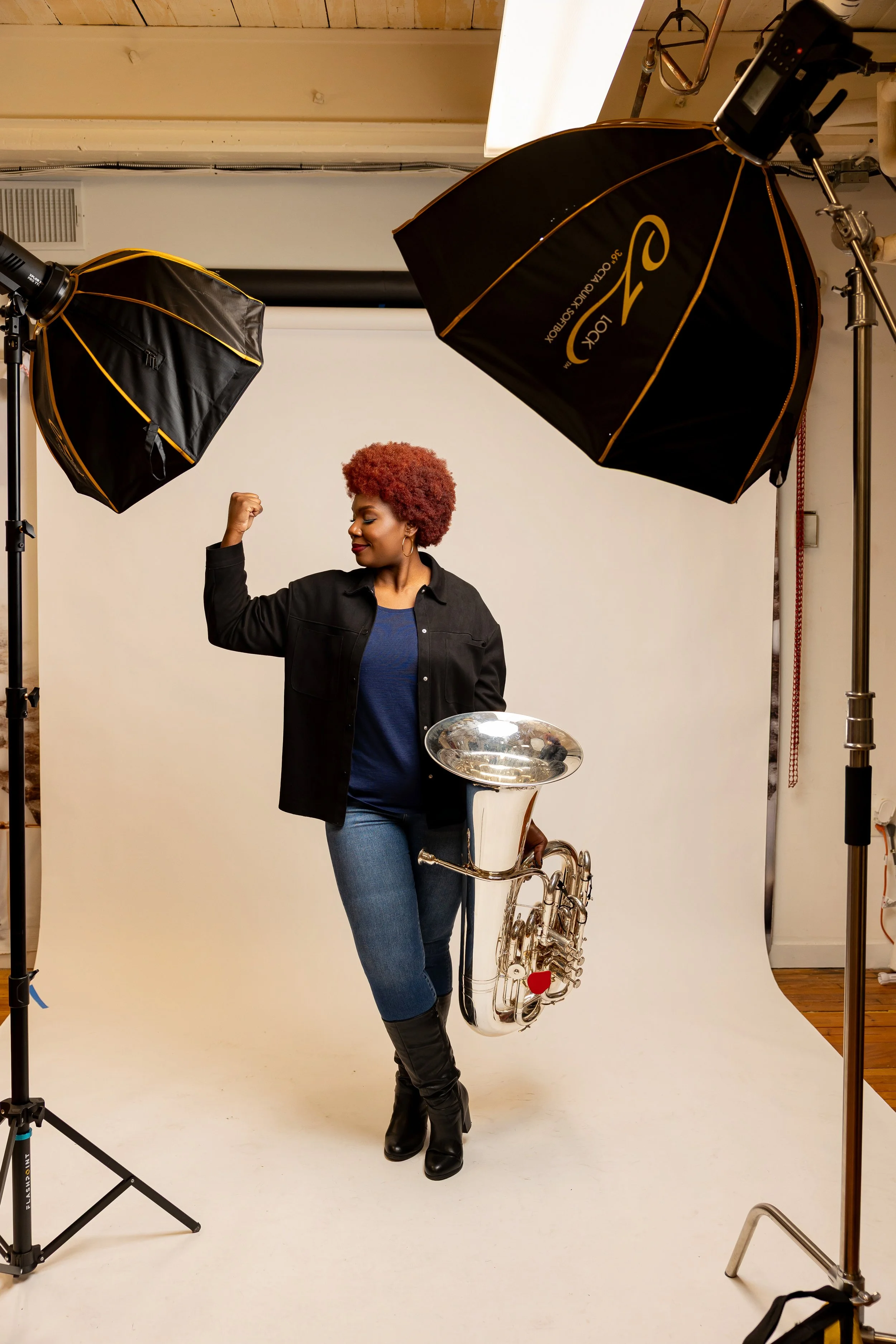
My Charge
Music is a universal language, and the tuba is my voice to speak it.
As a performer, I create programs that blur boundaries, weaving together tuba, poetry, narrative, and identity to build experiences that feel personal and resonant.
As a composer, I write music that centers storytelling—drawing from classical, contemporary, and popular influences to give performers and audiences something to experience together.
As an educator, I guide musicians toward connecting their craft with their identity, helping them sound like themselves rather than who they think they’re supposed to be.
Across every part of my work, my goal is simple: to help people discover their voice and feel seen.
When I perform, I want audiences to walk away feeling understood.
When I teach, I want musicians to leave with more clarity, tools, and curiosity than they came in with.
When I compose, I want performers to feel the music speaking for them.
That’s the story behind everything I do: music as language, tuba as voice, artistry as truth
What I Have Done
My work has always been rooted in truth, identity, and storytelling that invites people to see themselves more fully. That mission has carried me into concert halls, classrooms, and communities across the U.S. and internationally. From residencies at universities and conservatories to performances and workshops in Costa Rica and Colombia, I have brought this work to thousands of people.
I didn’t set out chasing accolades; I chased impact. But along the way, my voice has been recognized. I earned a D.M.A. in tuba performance from the Peabody Conservatory, placed in major solo competitions including the Falcone Festival and the Yale Gordon Competition, presented and performed at international conferences, and expanded my creative reach through projects like my EP Revolution, which celebrates Black composers, musicians, and musical traditions.
Today, I partner with ensembles, universities, and arts organizations to blend performance, composition, and storytelling into experiences that are honest, vulnerable, and transformative. I currently serve as the Adjunct Professor of Tuba at Rowan University and am a Meinl Weston Performing Artist—roles that allow me to teach, create, and empower musicians in the same way music has always empowered me.
-
In February 2020, Jasmine won first place in the Michigan State University’s Running Start Competition with her project Revolution: The Next Generation of Tuba Music. In this project, she commissioned 3 Black composers, Malachi Brown, Keeghan Fountain, and Daijana Wallace to write pieces featuring the tuba in Black music styles for an EP. With the pandemic closing things down, she ran a successful Kickstarter to fund the remainder of the project with the support of over 190 backers. The EP was released in July 2022 on streaming platforms and BandCamp.
Also during the pandemic, Jasmine formed the COVID-19 Black All Star Tuba-Euphonium Ensemble composed of young Black tuba and euphonium players around the United States. She released several videos from June to October of 2020, featuring arrangements of R. Nathaniel Dett’s In the Bottoms Suite and spiritual medleys. This concluded with a larger scale virtual performance of Lift Every Voice and Sing featuring over 25 Black tuba and euphonium players from all generations.
In 2022, Jasmine composed and wrote her first work for tuba and spoken word, Gateways. This was the first of the works in the Visions project of auto-biographical pieces for tuba and spoken word, allowing for her to share her story through her artistic mediums of performance, composition, and writing. Since then, she premiered Foundations and Reflections in 2023 and has works in progress to develop a full-length album of these pieces.
-
Jasmine is an international tuba soloist, having performed around the United States and Latin America. Hailed as one of the “promising artists of the twenty-first century,” she has been a featured guest artist at the 2022 Iberacademy Resonante Festivale in Colombia, 2022 International Women’s Brass Conference at the University of North Texas, and the 2023 International Tuba-Euphonium Conference at Arizona State University. At her earliest competition, the 2016 Leonard Falcone Tuba Student competition, she earned the bronze prize, becoming the first Black woman to place in the competition’s history. She has been a semi-finalist in the 2016 ITEC Young Artist Competition, 2017 NERTEC artist competition, 2020 NERTEC artist, mock-band audition, and mock-orchestra audition competitions. In April 2022, Jasmine became the first tuba player and Black woman to win the Peabody Conservatory’s Yale Gordon Competition.
In addition to competitions, festivals, and conferences, Jasmine has performed concertos with several community bands and high school ensembles, the Central Illinois Brass Band, Georgia Tech University, and the Peabody Conservatory. She has toured as a soloist and chamber musician at various other universities and concert series.
-
Up until her first year at Michigan State University, Jasmine had rarely attempted to seriously compose, believing it was not something she could do. In her beginning orchestration class, she had her first experience arranging for a large ensemble, beginning with her Spirituals of H. T. Burleigh for symphony orchestra in November 2019. After loving orchestration, she sought to continue with advanced orchestration the next semester, only, she did not realize the projects would now require her to compose. After sitting paralyzed at her computer for hours with the first assignment, contemplating dropping the class, she gave it a try and ended up not being terrible at it. Her first large ensemble composition, Quarantine(r) March, was written in two nights at the beginning of the pandemic due to a typical bout of procrastination in existential dread. However, that piece received praise from the rest of the class, giving her the confidence to write an artistic work for her final. Camouflage for Wind Ensemble was initially supposed to be an arrangement of Herbie Hancock’s Chameleon, but instead turned into its own composition.
Over the summer of 2020, Jasmine used the time to work on arranging for tuba and euphonium. Her first published quartet arrangement of Adoration, originally for organ by Florence Price, received much praise and has been since re-arranged for brass quintet and horn quartet. The COVID-19 Tuba-Euphonium Ensemble premiered her arrangements of all movements of R. Nathaniel Dett’s In the Bottoms, a spiritual medley, and “Lift Every Voice and Sing.”
In Spring 2021, Jasmine studied composition with Dr. Zhou Tian at Michigan State. She wrote her first solo tuba piece that she premiered, The Imposters for Solo Tuba, a duet in honor of her father, In Daddy’s Shoes, and her celebrated brass ensemble work Against All Odds. Against All Odds was written in honor of the Chromatic Brass Collective. It was premiered virtually by the group in the summer of 2021 and live at the 2022 International Women’s Brass Conference.
The performance of Against All Odds led to a commission for the work Midnight Escape (2023) by the Palisades Trumpet Collective. It was recorded and released on the group’s 2024 album Sojourn. Jasmine was commissioned by the Black Composer Revival Consortium for high school arrangements of In the Bottoms: Introduction and Juba Dance (2022). The arrangements for band, string orchestra, and full orchestra were funded by programs around North America and have been performed by groups of all ages. Jasmine’s largest work, Roots Torn, Routes Chosen: A Story of Black Migration , was premiered in November 2024 by the Long Island Philharmonia. This symphony for wind ensemble and spoken word goes through the different eras of Black migration in the United States.
-
Dr. Pigott has a B.M. in music education and tuba performance from Ithaca College, an M.M. in tuba performance from Michigan State University, and a D.M.A. in tuba performance from the Peabody Conservatory at Johns Hopkins. She is the first Black woman in history to earn a doctorate in tuba. Her teachers include: Velvet Brown, Phil Sinder, David Earll, and Justin Benavidez.
Dr. Pigott’s love for research began during her undergraduate studies at Ithaca College, where she worked with Dr. Matthew Clauhs on projects and publications on representation and beginning improvisation. In 2019 into 2020, she completed independent research projects on composer demographics in both the NYSSMA Solo Manual and the ITEA’s Solo Literature List. Her research on tuba repertoire was to be presented at the 2020 North Eastern Regional Tuba-Euphonium Conference, but it was canceled during the pandemic. She has since written out that research and used it as a foundation for her Revolution project.
Dr. Pigott maintained a blog and podcast on health, wellness, and activism from 2020 to mid-2021. Some of the blog posts as well as other articles have been published in the International Tuba-Euphonium Assosciation’s Journal, The Horn Call, and The Brass Legacy Journal. Dr. Pigott has given numerous presentations on health, wellness, and activism since 2020, presenting for students at institutions including: Georgia Tech, Ohio University, and University of Maryland Baltimore County. She was the keynote speaker at MSU’s Color Me Music recital in February 2020 and guest speaker at Howard University, hosted by their chapter of the Tau Beta Sigma National Honorary Band Sorority in February 2024.
For her D.M.A., Dr. Pigott completed her final research project on instrumental performance of the Negro Spiritual. Her lecture recital document and presentation, Reclaiming Authenticity: Capturing the Essence of Negro Spirituals in Instrumental Performance, is the basis for several upcoming pedagogical projects.
Dr. Pigott has been teaching privately since high school. In addition to her private studio, she has held positions at Ohio University, the Peabody Preparatory, the Athena Honor Band, and the LA Phil’s National Festival. She also substitutes with the Baltimore Symphony Orchestra’s OrchKids program and is a member of the Tuned-In Faculty team at the Peabody Preparatory and the Apex Arts Program, providing lessons and brass classes to students regardless of race and socio-economic status. Several of her students have been selected for All-State, All-County, and other regional youth orchestras and have gone on to pursue music at the collegiate level. She has given masterclasses at local middle and high schools, Ohio University, Ithaca College, and the University of Maryland Baltimore County. She also gave several masterclasses on her tours to Costa Rica and Colombia.
Short Bio
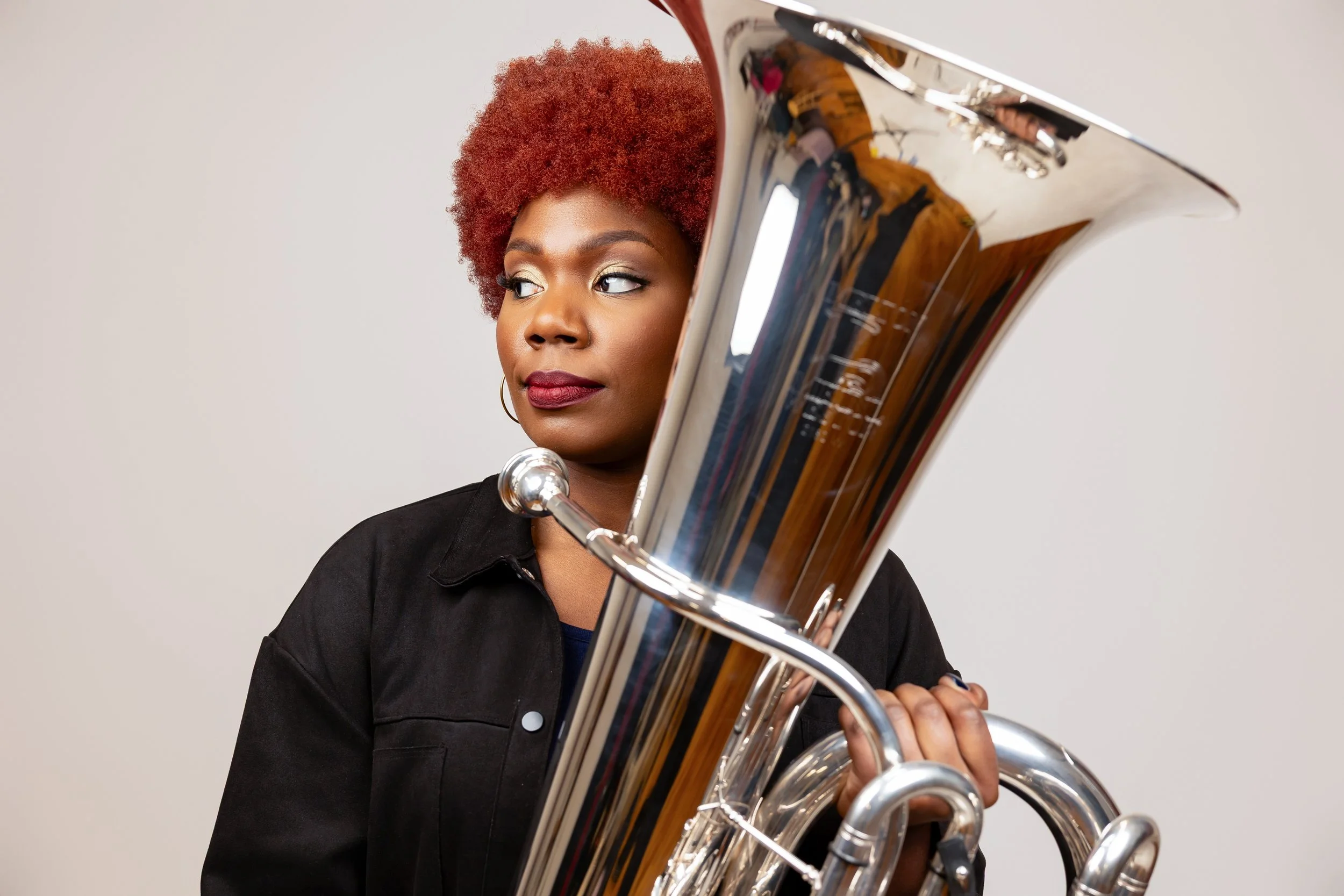
Dr. Jasmine “Jazzie” Pigott is a performer, composer, and educator known for expressive, narrative-driven artistry. A Meinl Weston Performing Artist, she tours internationally as a soloist and clinician, appears with her duo J² with euphoniumist Jermaine Fryer, and serves as the Adjunct Professor of Tuba at Rowan University.
Her interdisciplinary work centers storytelling, identity, and expression through performance, composition, and writing. Dr. Pigott holds a B.M. from Ithaca College, a M.M. from Michigan State University, and a D.M.A. from the Peabody Conservatory at the Johns Hopkins University.